
Let us take a closer look at the importance of the flange system in a CVD tube furnace. It can be said that the flange system is the “gateway” and the “critical passage” of the entire CVD equipment, and its importance cannot be overstated.
It is far more than a simple connecting component. It directly determines the success or failure of the following core performance aspects:
I. Four Key Aspects of Its Core Importance
1. Ensuring the Integrity of Vacuum and Atmosphere (Sealing – The Seal)
This is the most fundamental and crucial function of the flange.
Creating a controlled environment:
A CVD process requires operation under precisely controlled atmospheres (high-purity inert gases, reactive gases, and specific vacuum levels). Through its precision sealing design (such as O-rings and metal gaskets), the flange system ensures that the reaction chamber (quartz tube) is completely isolated from the external atmosphere.
Maintaining process stability:
Even tiny leaks can introduce impurities (such as oxygen and moisture). These impurities are fatal to the growth of high-quality materials (such as graphene and boron nitride), acting as defect centers that seriously degrade electrical, optical, and structural properties. Good flange sealing is the foundation of experimental repeatability.
Ensuring vacuum performance:
Vacuum pumps are connected to the furnace body through flange interfaces. If a flange leaks, the system cannot reach the required ultimate vacuum level, the pumping time increases, and pump oil deteriorates quickly due to continuous air intake.
2. Enabling Modular Operation and Accessibility (Modularity – The Access)
Flange design provides excellent flexibility and convenience to the CVD system.
Easy sample loading:
Both ends of the tube furnace can be opened via the flanges, allowing for easy loading and retrieval of substrates and boats. Quick-release (QF/KF) flange designs enable this to be completed within minutes, significantly improving research efficiency.
System maintenance and cleaning:
When cleaning the quartz tube or the furnace chamber is required, the detachable flange connections make maintenance feasible and simple.
Functional expansion:
Standard interfaces (such as CF and KF) on the flanges allow users to flexibly add functional modules, such as:
- Additional vacuum gauges for pressure monitoring
- Observation windows for process monitoring
- Electrical feedthroughs for substrate heating or biasing
- Special gas injection systems
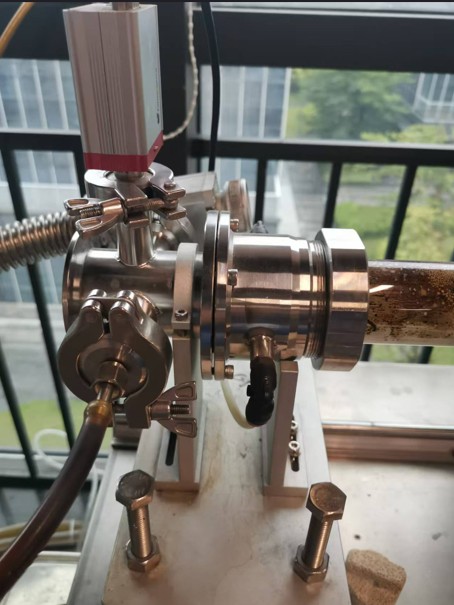
3. Ensuring Accurate Control of Process Gases (Flow Field Control – The Flow)
The structure of the flange directly affects the flow distribution of reaction gases inside the tube, and the flow field is a key factor influencing the uniformity of material growth.
Gas inlet design:
The inlet-side flange usually integrates gas distribution structures (such as porous nozzles and multi-channel inlets), ensuring that reaction gases enter the reaction zone smoothly and uniformly, avoiding turbulence that causes non-uniform growth.
Exhaust design:
The outlet-side flange guides by-product gases and unreacted gases smoothly out of the system and connects to exhaust treatment units (such as bubblers and burners).
Pressure balance:
A solid and well-sealed flange ensures a stable pressure environment inside the tube, which is essential for maintaining laminar flow. Laminar flow is necessary for achieving uniform deposition.
4. Ensuring Equipment and Personnel Safety (Safety – The Safety)
CVD processes often involve high temperatures, pressure differentials, flammable and explosive gases (such as H₂ and CH₄), and toxic gases (such as CO). The flange system is the first line of defense.
Pressure resistance:
The furnace tube operates under vacuum or positive pressure. Flanges and fasteners must withstand the corresponding load to prevent rupture.
Leak prevention:
A tight seal prevents toxic or flammable gases from leaking into the laboratory environment, protecting operator safety.
Interlock functions:
Advanced systems may connect flange interfaces to safety interlocks—e.g., the system allows hazardous gas flow or heating only when the flanges are properly closed and sealed.
2.Consequences of Flange System Failure
If the flange system has issues (such as incorrect selection, improper installation, or aging seals), it can directly lead to:
- Experimental failure: materials cannot grow or exhibit poor quality, unevenness, and low repeatability
- Equipment damage: pump oil contamination, heater oxidation due to oxygen leakage, and quartz tube cracking from localized overheating
- Resource waste: wasted high-purity gases and valuable experimental time
- Safety risks: gas leaks, fire, poisoning, and other hazards
Conclusion
The flange system of a CVD tube furnace can be compared to the docking hatch of a spacecraft:
- Sealing determines the purity and stability of the internal environment (like life-support inside a spacecraft)
- Modularity provides access and expansion capability (like astronaut and cargo transfer)
- Flow control affects the core process (like the air circulation system)
- Safety ensures that the system operates flawlessly under all conditions
Therefore, when selecting, installing, and maintaining a CVD tube furnace, the flange system must be given the highest level of attention. Although it appears to be a “component,” it is the cornerstone that determines the performance, efficiency, and safety of the entire system.
Investing in a well-designed and well-maintained flange system will save countless troubles in CVD research and ensure data reliability and operational safety.

 English
  German
  Russian
  French
  Spanish
  Italian